Recognizing the Early Signs of Alzheimer's in Your 50s Before It's Too Late
Verified By Dr. Sorabh Gupta | 17-Dec-2025
Dr. Sorabh Gupta, Consultant Neurologist at Kailash Hospital, leans forward, his expression one of grave concern.
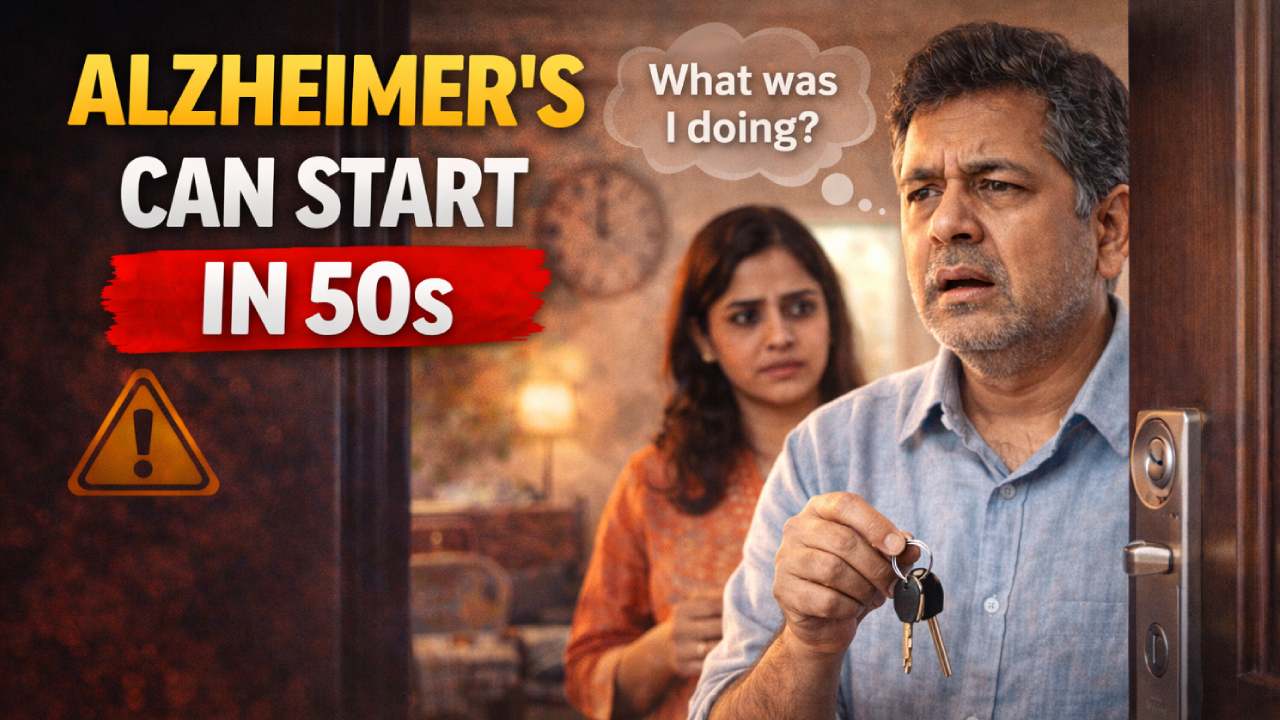
"When a 55-year-old executive can't remember the agenda of a meeting he just left, we are no longer talking about simple forgetfulness. We are likely witnessing the first, silent strokes of early onset Alzheimer's." This scenario is becoming tragically common in neurology clinics across India. Alzheimer's disease is no longer solely an ailment of the elderly. With over 4 million Indians living with dementia and a significant portion experiencing onset before 65, recognizing the early signs of Alzheimer's in 50s has become a critical public health imperative.
This guide, drawing on the expertise of Dr. Gupta and the advanced neurology department at Kailash Hospital, will decode the subtle yet distinct differences between normal aging and the harbingers of dementia, empowering you to seek timely intervention.
Table of Content
Early onset Alzheimer's refers to the form of the disease that strikes individuals under the age of 65, typically in their 40s and 50s. Its impact is uniquely devastating.
- Financial and Professional Peak: Individuals in their 50s are often at the peak of their careers, with complex job responsibilities, financial obligations, and families to support.
- Misdiagnosis is Common: The symptoms of Alzheimers disease in a 50-year-old are frequently misattributed to stress, menopause, depression, or just "burnout," delaying crucial diagnosis for years.
- Genetic Factors: A higher proportion of early-onset cases have a genetic component, which has implications for entire families.
"The greatest challenge we face," explains Dr. Sorabh Gupta, "is breaking the stigma. Patients and families often dismiss the first sign of Alzheimers out of fear or denial. But early diagnosis is not a death sentence; it is a battle plan. It allows us to intervene when treatments and lifestyle changes can be most effective at slowing the progression."
Also read: Clearing the Clouds: How to Fix Brain Fog and Regain Mental Clarity
The early signs of Alzheimers disease are often subtle and creep in insidiously. They extend far beyond misplacing keys.
1. Memory Loss That Disrupts Daily Life (The Most Common First Sign of Alzheimers)
This is not forgetting a name and recalling it later. This is:
- Repeatedly asking for the same information.
- Increasing reliance on memory aids (notes, reminders) for things they used to handle easily.
- Forgetting important dates, events, or things you've recently learned.
- Key Difference: Normal aging might involve forgetting an appointment but remembering it later. Alzheimer's involves forgetting the appointment entirely.
2. Challenges in Planning or Solving Problems
A noticeable change in the ability to work with numbers or follow a plan emerges. This can manifest as:
- Difficulty following a familiar recipe.
- Trouble keeping track of monthly bills or managing a budget, a task they previously mastered.
- Inability to concentrate and take much longer to do things than before.
3. Difficulty Completing Familiar Tasks
People may find it hard to complete daily tasks they have done their entire lives. This includes:
- Forgetting the rules of a favorite game, like bridge or chess.
- Getting lost while driving to a familiar location, like the local market or their own neighborhood.
- Struggling to operate common appliances, like the microwave or television remote.
4. Confusion with Time or Place
Losing track of dates, seasons, and the passage of time is a major red flag. Individuals may:
- Forget where they are or how they got there.
- Struggling to grasp something when it’s not happening right in front of you.
- Dr. Gupta notes: "A patient might vividly recall a event from 30 years ago but have no memory of what they had for breakfast. This disconnect between remote and recent memory is classic."
5. Trouble Understanding Visual Images and Spatial Relationships
This is not just a need for new glasses. Vision problems can be a sign of Alzheimer's, leading to:
- Difficulty reading, judging distance, and determining color or contrast.
- Problems with perception, which may cause issues with driving.
- Not recognizing their own reflection in a mirror.
6. New Problems with Words in Speaking or Writing
Struggling to join or follow a conversation is a telling sign. They may:
- Have you ever found yourself in the middle of a conversation, completely stumped about how to keep it going?
- Repeat themselves.
- Struggle with vocabulary, using the wrong word for things (e.g., calling a "watch" a "hand-clock").
7. Misplacing things and then struggling to retrace your steps
We all misplace things. A person with Alzheimer's will do this more frequently and will be unable to retrace their steps to find them. They may:
- Put things in unusual places (e.g., car keys in the refrigerator).
- Accuse others of stealing, especially as the disease progresses.
Not every memory lapse is a cause for panic. However, Dr. Gupta advises that you should schedule a consultation with a neurologist in Dehradun. if:
- You or a loved one are experiencing multiple symptoms from this list.
- The symptoms are gradually worsening over time.
- The cognitive changes are interfering with work, social activities, or family life.
"At Kailash Hospital," he explains, "we don't just guess. We conduct a comprehensive evaluation to rule out other conditions that can mimic dementia, such as thyroid disorders, vitamin B12 deficiency, depression, or side effects of medication."
Also read: Understanding Senility: Early Signs, Symptoms, and How to Care for Seniors
The journey to a diagnosis involves several steps:
- Detailed Medical History: A thorough discussion of symptoms, family history, and overall health.
- Cognitive and Neuropsychological Tests: These assess memory, problem-solving, attention, and language skills.
- Neurological Exam: To test reflexes, coordination, and sensory function.
- Blood Tests: To rule out other potential causes of symptoms.
- Brain Imaging (MRI/PET Scans): MRI can rule out tumors or strokes. Advanced PET scans can detect the amyloid plaques characteristic of Alzheimer's in the brain.
While there is no cure, an early diagnosis opens the door to management strategies that can significantly improve quality of life:
- Medication: Cholinesterase inhibitors can help manage memory and thinking symptoms for some time.
- Lifestyle Modifications: Evidence shows that a heart-healthy diet (like the Mediterranean diet), regular physical exercise, cognitive stimulation, and social engagement can help slow progression.
- Clinical Trials: Early diagnosis may make patients eligible for groundbreaking new clinical trials for emerging treatments.
- Future Planning: It allows the individual and their family to plan for the future—financially, legally, and medically—while the person can still participate in decision-making.
Also read: What is the difference between Alzheimer's and Dementia?
The early signs of Alzheimer's in your 50s are a call to action, not a reason for despair. Ignoring them only allows the disease a greater head start. The symptoms of Alzheimers disease are a thief in the night, but with vigilance, we can turn on the lights.
As Dr. Sorabh Gupta of Kailash Hospital emphatically states, "Your brain is your most precious asset. Do not dismiss its cries for help. If you see these signs of Alzheimers disease in yourself or someone you love, take the brave step of getting evaluated. At Kailash Hospital, our neurology team is equipped with the latest technology and deep expertise to provide a precise diagnosis and a compassionate, comprehensive care pathway. Early action is the closest thing we have to a weapon against this disease. Use it."
Do not wait. If you have concerns, schedule a consultation with a neurologist today. Your future self may thank you for it.









 +91-9711918451
 international.marketing@kailashhealthcare.com